Indiana Combination Vehicles Study Guide
This page covers the Combination Vehicles portion of the CDL exam as administered by the Indiana Bureau of Motor Vehicles in Indiana. The endorsement code is GK (Class A). Below you'll find what's tested, focused study notes, and a direct link to a 25-question Indiana-specific practice test.
Take the IN Combination Vehicles Practice Test →
What's on the test
- Coupling and uncoupling procedures (tractor-to-semitrailer)
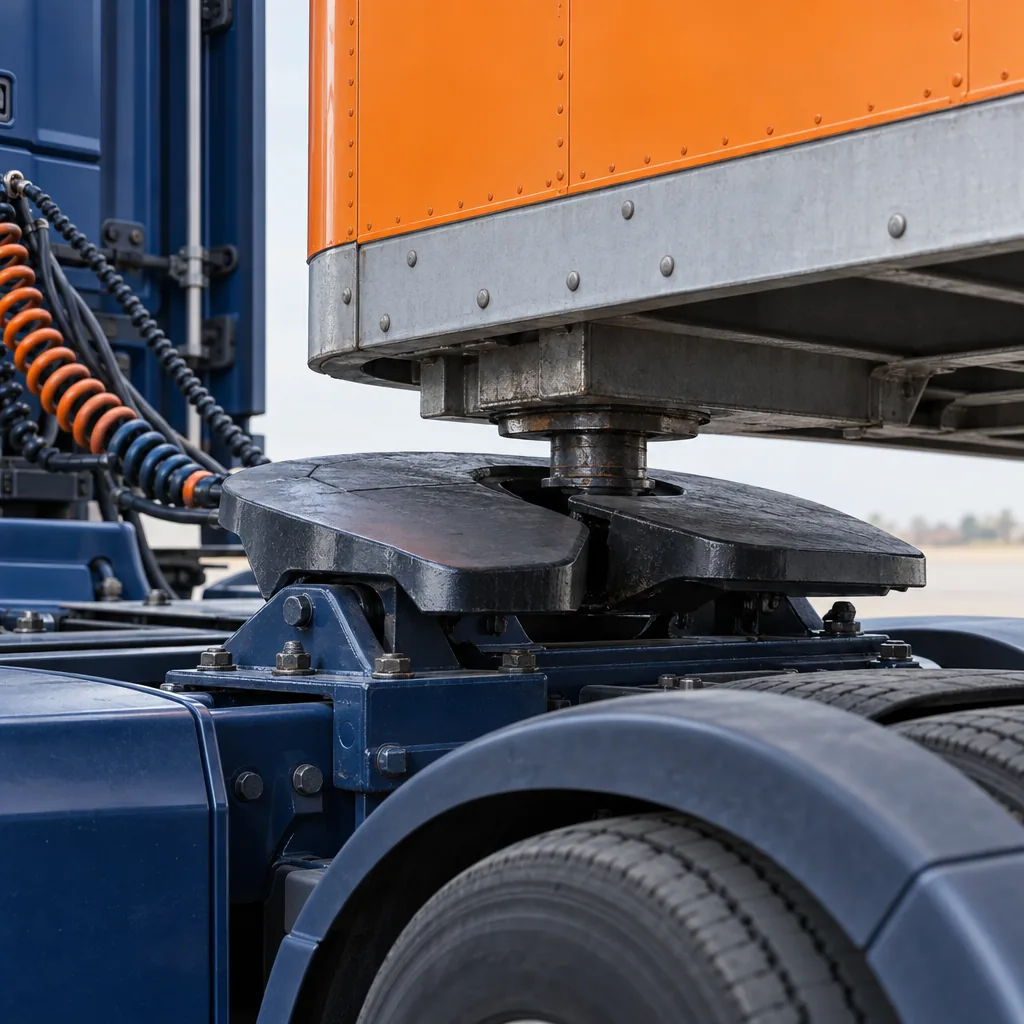
- Fifth wheel inspection and locking
- Trailer hand valve / trolley valve and when not to use it
- Off-tracking on right turns
- Rollover prevention and high center of gravity
- Trailer brakes, anti-lock brakes (ABS), and emergency braking
- Backing a trailer (steering inputs, GOAL principle)
- Air and electrical lines (glad hands and seven-pin connector)
Study notes
Coupling order matters.
Block the trailer wheels, raise the trailer to the proper height (slightly low so the trailer is lifted by the fifth wheel), back slowly under the trailer, lock the fifth wheel, hook up the air and electrical lines, charge the trailer brakes, then test the coupling by gently tugging forward against the locked trailer brakes.
Never use the trailer hand valve to park or hold against a grade.
The trolley valve applies only the trailer service brakes and is intended for testing the trailer brake separately. If you set it as a parking device, the brakes can leak off and the vehicle will roll. Always set the trailer parking brakes when you stop.
Off-tracking is why CDL drivers swing wide on right turns.
The trailer wheels follow a tighter arc than the tractor wheels. To keep the trailer from running over the curb, you have to make a wider initial swing — but only after committing the cab to the turn so a passenger car can't squeeze in beside you on the right.
Combination vehicles roll long before they slide.
The high center of gravity of a loaded trailer means rollover is the single biggest combination-vehicle crash type. Half of fatal truck rollovers happen at speeds the driver thought were safe. Slow down before the curve, not in it, and never trust posted ramp-speed signs alone — those are calibrated for cars.
ABS does not stop you faster.
ABS is designed to keep you from skidding so you can keep steering. On dry pavement with a panic stop, an ABS-equipped truck may take the same distance or even slightly more than a non-ABS truck. The benefit is control, not distance.
Indiana-specific notes
In Indiana, the Combination Vehicles knowledge exam is one of several written tests administered at Indiana Bureau of Motor Vehicles CDL testing offices. Most applicants take it on the same day as the General Knowledge test. The vocabulary and question style match the official Indiana CDL handbook closely, which is why we recommend reading the relevant chapter of the handbook in addition to working through our practice tests. Pay particular attention to the chapter's "key terms" sidebars — those are almost always the source of vocabulary-style multiple-choice questions on the real exam.
If your test vehicle is equipped with air brakes, you must additionally pass the Air Brakes knowledge test or the air-brake portion will be removed from your license as an L-restriction. The skills test (vehicle inspection, basic control, and on-road) is administered by Indiana Bureau of Motor Vehicles examiners or by approved third-party testers. Bring your CLP, your medical certificate, and proof of insurance for the test vehicle.
A handful of Indiana-specific quirks worth knowing: the office may require a separate appointment for the skills test versus the knowledge test; many Indiana testing offices do not allow rental commercial vehicles for the skills test; and you generally need to wait at least one business day between failed attempts on the same knowledge exam (your office may extend that further on subsequent failures).
Test-day strategy
Read every question twice. CDL exam writers love to insert a single qualifier — "always," "never," "only," "primary" — that flips the right answer. When two answers look almost identical, pay attention to the verb (is it "must," "should," or "may"?), and to any numbers (14 days, 100 air miles, 8 hours). On endorsement tests in particular, watch for trick framing where a true statement about a different endorsement is offered as the "correct" answer.
Don't second-guess yourself. Your first instinct is correct on roughly 70% of CDL knowledge questions, and changes most often turn a right answer into a wrong one. Mark the questions you're unsure of, finish the rest of the exam quickly, then go back and reconsider only the marked questions with the time you have left.