What's tested
- Coupling and uncoupling procedures (tractor-to-semitrailer)
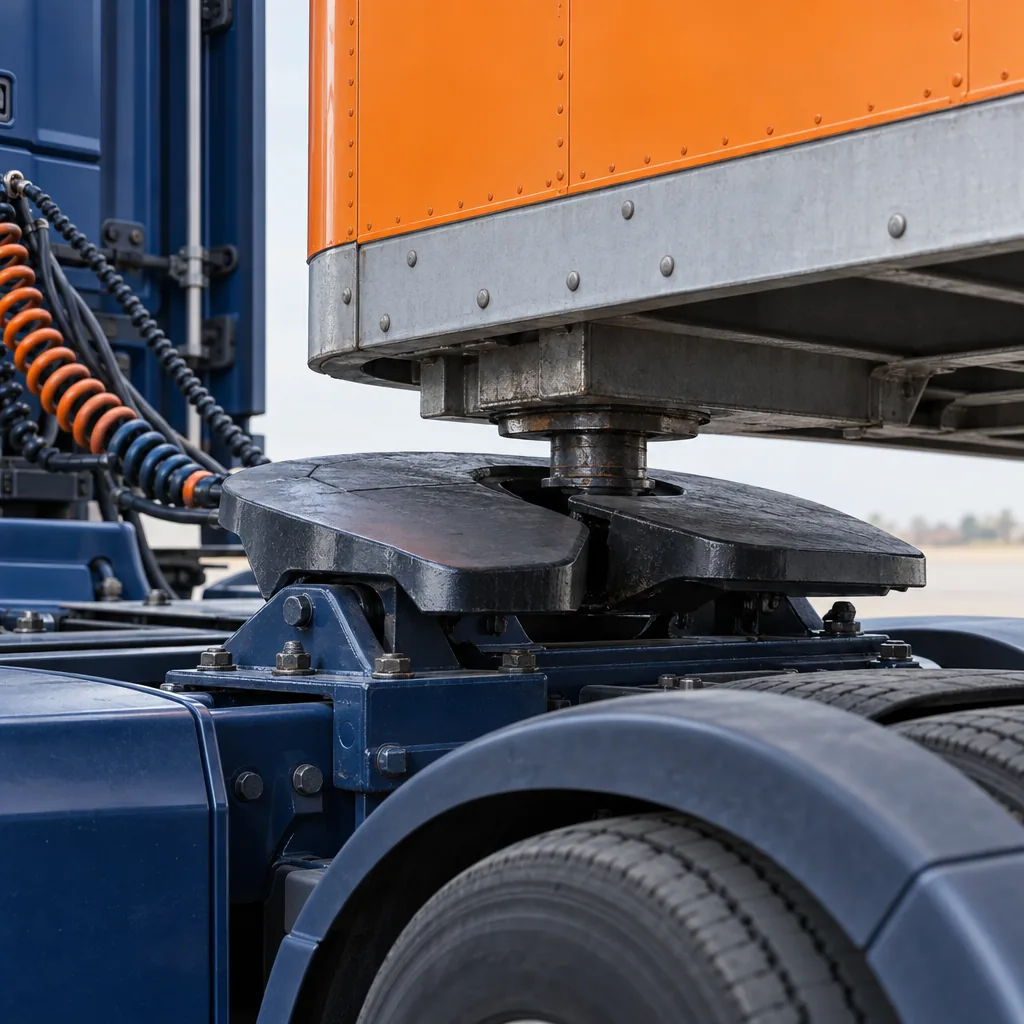
- Fifth wheel inspection and locking
- Trailer hand valve / trolley valve and when not to use it
- Off-tracking on right turns
- Rollover prevention and high center of gravity
- Trailer brakes, anti-lock brakes (ABS), and emergency braking
- Backing a trailer (steering inputs, GOAL principle)
- Air and electrical lines (glad hands and seven-pin connector)
Study notes
Coupling order matters.
Block the trailer wheels, raise the trailer to the proper height (slightly low so the trailer is lifted by the fifth wheel), back slowly under the trailer, lock the fifth wheel, hook up the air and electrical lines, charge the trailer brakes, then test the coupling by gently tugging forward against the locked trailer brakes.
Never use the trailer hand valve to park or hold against a grade.
The trolley valve applies only the trailer service brakes and is intended for testing the trailer brake separately. If you set it as a parking device, the brakes can leak off and the vehicle will roll. Always set the trailer parking brakes when you stop.
Off-tracking is why CDL drivers swing wide on right turns.
The trailer wheels follow a tighter arc than the tractor wheels. To keep the trailer from running over the curb, you have to make a wider initial swing — but only after committing the cab to the turn so a passenger car can't squeeze in beside you on the right.
Combination vehicles roll long before they slide.
The high center of gravity of a loaded trailer means rollover is the single biggest combination-vehicle crash type. Half of fatal truck rollovers happen at speeds the driver thought were safe. Slow down before the curve, not in it, and never trust posted ramp-speed signs alone — those are calibrated for cars.
ABS does not stop you faster.
ABS is designed to keep you from skidding so you can keep steering. On dry pavement with a panic stop, an ABS-equipped truck may take the same distance or even slightly more than a non-ABS truck. The benefit is control, not distance.
How to study for the Combination Vehicles exam
The single best preparation strategy for any CDL endorsement is to read the relevant chapter of your state's official CDL handbook three times: once to skim, once to highlight, and once to test yourself on the key terms in the chapter sidebars. The questions on the real exam are drawn directly from the handbook, often phrased almost identically to the bolded vocabulary terms. After you've read the chapter, work through every Combination Vehicles practice test on CDL Study Hub for the state you live in.
Pace yourself. Most candidates who fail an endorsement exam fail because they tried to cram all eight written tests into a single weekend. Spread your study over two to three weeks, doing 30 minutes a night, and your retention will be dramatically better than a marathon Saturday session. The Combination Vehicles material in particular rewards spaced repetition because it includes a lot of numbers, regulations, and procedural steps that don't stick after a single pass.
Take the practice test in your state
Every state writes its own version of the Combination Vehicles exam, but they all conform to the same FMCSA standards. Pick your state below for a 25-question practice test sampled from the CDL Study Hub question bank.
AL Alabama
Practice test
AK Alaska
Practice test
AZ Arizona
Practice test
AR Arkansas
Practice test
CA California
Practice test
CO Colorado
Practice test
CT Connecticut
Practice test
DE Delaware
Practice test
DC District of Columbia
Practice test
FL Florida
Practice test
GA Georgia
Practice test
HI Hawaii
Practice test
ID Idaho
Practice test
IL Illinois
Practice test
IN Indiana
Practice test
IA Iowa
Practice test
KS Kansas
Practice test
KY Kentucky
Practice test
LA Louisiana
Practice test
ME Maine
Practice test
MD Maryland
Practice test
MA Massachusetts
Practice test
MI Michigan
Practice test
MN Minnesota
Practice test
MS Mississippi
Practice test
MO Missouri
Practice test
MT Montana
Practice test
NE Nebraska
Practice test
NV Nevada
Practice test
NH New Hampshire
Practice test
NJ New Jersey
Practice test
NM New Mexico
Practice test
NY New York
Practice test
NC North Carolina
Practice test
ND North Dakota
Practice test
OH Ohio
Practice test
OK Oklahoma
Practice test
OR Oregon
Practice test
PA Pennsylvania
Practice test
RI Rhode Island
Practice test
SC South Carolina
Practice test
SD South Dakota
Practice test
TN Tennessee
Practice test
TX Texas
Practice test
UT Utah
Practice test
VT Vermont
Practice test
VA Virginia
Practice test
WA Washington
Practice test
WV West Virginia
Practice test
WI Wisconsin
Practice test
WY Wyoming
Practice test